Utilities can decide the model
Equipment-heavy businesses should stress-test power, water, repairs and downtime before trusting revenue projections.
Source: SBA
Business guides
Melbourne music studios need community, credible teachers and a suburb where weekly lessons are practical. The city’s arts culture helps, but retention still depends on timetable fit for families, students and adults returning to music.
Overview
A Melbourne music studio is a retention and scheduling business more than a one-off enrolment business. The key feasibility questions are lesson frequency, room utilisation, teacher recruitment, after-school demand and whether adult hobby learners or exam-focused families dominate the catchment. Keep one-to-one lessons, group classes, holiday workshops, exam preparation and recital events separate so the model reflects true room and teacher usage. A studio can look busy in trial periods yet still struggle if recurring enrolments are weak or scheduling is awkward.
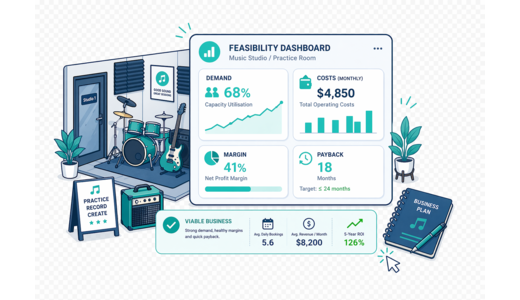
Key stats
Utilities can decide the model
Equipment-heavy businesses should stress-test power, water, repairs and downtime before trusting revenue projections.
Source: SBA
Capital is locked in early
Fit-out, machinery, lease works and maintenance reserves make staged spending more important than a glossy launch.
Source: business.gov.au
Location still matters
Even semi-automated operations need the right catchment, access, parking and visibility.
Source: SCORE
Key concepts
After-school piano lessons in a family suburb require a different timetable from evening guitar lessons for adult hobbyists near inner-city apartments. Melbourne can support both models, but each needs its own site logic and teacher mix.
Brunswick and Fitzroy may reward community-led creative identity, while more polished inner-south markets can support premium presentation if convenience and teacher quality are strong. Pick the suburb where the lesson habit feels practical, not aspirational.
Lesson businesses often launch with strong curiosity and then settle into a slower rhythm. Forecast around conservative recurring enrolment through school terms and colder months, with workshops and recitals treated as support rather than salvation.
Teacher cover, administration, instrument maintenance, room setup and child-safety processes all create real operating cost. The room schedule needs to justify them.
Audience and industry
Customers for a music studio or practice room business in Melbourne should be described by routine, not by broad demographics. Identify who buys, when they buy, how often they return, what alternatives they compare, and how far they will travel. For this business, the first demand hypothesis to prove is repeat local demand, visible catchment fit and sustainable booking or transaction volume.
Melbourne’s creative reputation supports interest in lessons, but parents and adult learners both compare convenience and teacher quality closely. A generic timetable without community or progression usually struggles against established local operators.
Competition in Melbourne is not just the nearest similar operator. Include substitutes, online options, supermarkets, gyms, marketplaces, delivery platforms, shopping centres, petrol sites, home alternatives and any business that solves the same customer problem. Visit competitors at the same times you expect to trade.
Key factors
Proof of repeat local demand, visible catchment fit and sustainable booking or transaction volume in the exact Melbourne catchment.
Rent, outgoings, lease obligations and fit-out spend compared with conservative sales.
capacity utilisation, staffing coverage, customer experience, stock or equipment control and repeat sales routines
contribution margin after direct costs, labour pressure and occupancy cost
Enough cash to survive delays, learning, seasonality and slower repeat-customer growth.
Finance model
Business Model Canvas
Specific Melbourne customers with repeat need for repeat local demand, visible catchment fit and sustainable booking or transaction volume.
A music studio offer that is easier, faster, more trusted or more local than the alternatives.
Street visibility, local search, referrals, social proof, partnerships, delivery or marketplace channels as appropriate.
Sales driven by repeat local demand, visible catchment fit and sustainable booking or transaction volume; test price, volume and repeat rate separately.
rent, wages, supplies, product cost, utilities, insurance and payment fees; split fixed costs, variable costs and launch costs.
capacity utilisation, staffing coverage, customer experience, stock or equipment control and repeat sales routines
A suitable site or channel, trained people, reliable suppliers, systems, permits and enough runway.
Landlord, suppliers, advisers, local marketers, delivery or fulfilment providers, and maintenance support.
Evidence-based assumptions, staged spending, conservative break-even checks and clear exit conditions.
Common mistakes
Assuming artistic interest guarantees recurring lessons
Prove that the local audience can realistically attend every week and stay enrolled over time.
Overbuilding rooms before demand is clear
Match room count and fit-out quality to conservative timetable utilisation.
Relying on recitals to fix weak lessons
Make the core lesson schedule viable first and treat events as community support, not the business model.
Case studies
A compact scenario showing how one assumption can change the result.
A compact scenario showing how one assumption can change the result.
Decision tree
Move to rent, capacity and margin stress tests.
Keep researching, pre-selling or testing with a smaller commitment.
Review startup risk, funding and compliance with advisers.
Renegotiate rent, reduce scope, change location or pause.
Prepare a launch plan with measured weekly review points.
Fix capacity, staffing, supplier or process constraints before spending more.
Self-evaluation
Early stage: tighten the assumptions before treating this as feasible.
Decision point
Use the simulator as a structured sanity check. It should support adviser conversations, not replace them.
Test your idea
Where you trade
The guide above works as a planning framework. Confirm the rules, taxes and local context below before you commit.

Checklist
FAQ
Family-heavy suburbs can support structured after-school timetables, while Brunswick, Fitzroy and some inner-city areas may also support adult hobby or creative-community demand. Choose the suburb where the weekly lesson routine is easiest to maintain.
Keep one-to-one lessons, group classes, workshops and events separate so room time and teacher allocation stay visible. Then test recurring enrolment by term rather than counting all enquiries as long-term students.
Check lease use, noise expectations, child-safety obligations, employment arrangements, music licensing where relevant, public liability insurance and building safety before signing a lease.
No. It is early planning support to help you structure assumptions before seeking qualified advice on finance, tax, lease, employment and compliance matters.
Sources
Disclaimer: smallbizsim.com provides indicative planning estimates only. It is not financial, legal, tax or investment advice. Verify assumptions with qualified advisers before making decisions.