Platform rules are a cost
Marketplace sellers need to price for fulfilment, advertising, returns, storage and policy changes rather than treating online reach as free demand.
Source: Amazon Seller Central
Business guides
Online reach is seductive, but a marketplace business lives or dies on product choice, ad spend, fees, reviews, inventory timing and platform rules.
Localise this guide
Overview
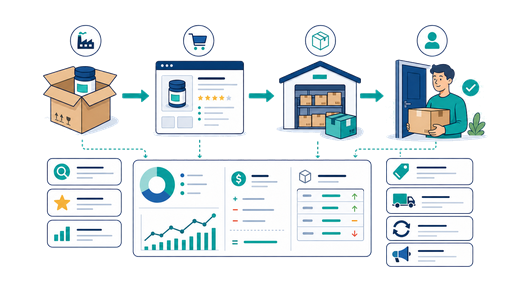
The store works when a product has defensible demand after fees, advertising, returns and inventory cash cycles are fully counted. In practical terms, this is the Amazon store investment story about search volume, competitor review gaps, repeat purchase potential, supplier reliability and tested conversion economics, landed cost, marketplace fees, fulfilment, advertising cost, returns, price position and reorder timing, and the discipline to avoid scaling ad spend or inventory before knowing true contribution margin after all platform costs.
Key stats
Platform rules are a cost
Marketplace sellers need to price for fulfilment, advertising, returns, storage and policy changes rather than treating online reach as free demand.
Source: Amazon Seller Central
Cash flow comes first
E-commerce can grow sales while consuming cash through inventory buys, ad spend and delayed payouts.
Source: SBA
Consumer law still applies
Online sellers still need clear claims, returns handling and truthful pricing.
Source: ACCC
Key concepts
Calculate landed cost, referral fees, fulfilment, storage, advertising, returns and replacements before calling an item profitable.
A product with demand but no differentiation can become a price war.
Test small orders and quality controls before tying up cash in a large shipment.
Inventory must often be bought before revenue arrives.
Ad spend can rise before reviews and organic ranking improve.
Model reorder timing so a promising product does not stock out or overstock.
Audience and industry
This guide is for founders, buyers and side-hustle operators asking whether the Amazon store deserves more time, money and professional due diligence.
E-commerce keeps growing, but competition is transparent and platform economics reward disciplined operators more than dreamers.
Compare marketplace sellers, private-label brands, retail arbitrage, direct-to-consumer sites and offline substitutes.
Key factors
search volume, competitor review gaps, repeat purchase potential, supplier reliability and tested conversion economics
landed cost, marketplace fees, fulfilment, advertising cost, returns, price position and reorder timing
supplier lead times, storage limits, listing quality, review velocity and cash tied in inventory
scaling ad spend or inventory before knowing true contribution margin after all platform costs
a narrow product niche with clear differentiation, reliable supply and a listing that converts without endless discounting
Finance model
Business Model Canvas
marketplace shoppers searching for a specific product, comparing price, reviews, delivery speed and trust signals
a narrow product niche with clear differentiation, reliable supply and a listing that converts without endless discounting
Volume multiplied by realised price, with add-ons and repeat frequency tested separately.
Direct costs first, then rent, wages, utilities, software, maintenance, marketing and startup capital.
Conservative assumptions, staged spending, local quotes and clear break-even checks before commitment.
Common mistakes
Mistaking opening-week attention for repeat demand.
Separate curiosity traffic from customers who return at sustainable prices.
Letting the lease decide the business model.
Model rent and fixed costs against a conservative demand case before signing.
Ignoring the operating bottleneck.
Check supplier lead times, storage limits, listing quality, review velocity and cash tied in inventory before assuming more sales are physically possible.
Underfunding the ramp-up period.
Keep working capital for delays, training, mistakes, repairs and slower-than-planned demand.
Case studies
A compact scenario showing how one assumption can change the result.
A compact scenario showing how one assumption can change the result.
Decision tree
Move to quote-based costing and capacity stress tests.
Pause spending and collect better local evidence first.
Test whether the upside case is operationally deliverable.
Reduce fixed costs, narrow the offer or find a different site.
Turn that promise into menu, pricing, staffing and marketing decisions.
Sharpen the concept before committing capital.
Self-evaluation
Early stage: tighten the assumptions before treating this as feasible.
Decision point
Use the simulator as a structured sanity check. It should support adviser conversations, not replace them.
Test your idea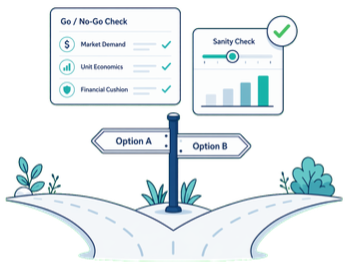
Where you trade
The guide above works as a general planning framework. Pick your country for rules, taxes and local context.

Checklist
FAQ
Test product price, landed cost, referral fees, FBA or fulfilment costs, advertising, returns, storage fees, monthly sales and stock cash flow.
ACoS means advertising cost of sales. It shows how much you spend on ads compared with the sales those ads generate.
Not always. FBA can improve delivery speed and Prime eligibility, but fees, storage and returns can reduce margin. Compare both options.
No. It is an early planning tool to help you ask better questions before speaking with an accountant, adviser or marketplace specialist.
Sources
Disclaimer: smallbizsim.com provides indicative planning estimates only. It is not financial, legal, tax or investment advice. Verify assumptions with qualified advisers before making decisions.