Local services win locally
A small service business should validate nearby demand, licences, insurance and the owner’s operating role before buying equipment or fitting out.
Source: business.gov.au
Business guides
The haircut is the product, but the repeat booking is the asset. Feasibility depends on chair utilisation, barber retention, rent and whether clients trust the experience enough to return on schedule.
Localise this guide
Overview
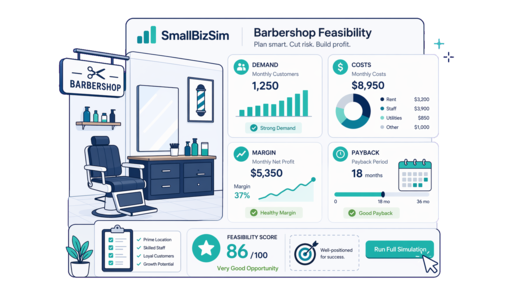
A barbershop works when each chair has enough repeat clients at the right price to pay for skill, space and downtime. In practical terms, this is the barbershop investment story about nearby wait times, repeat booking behaviour, local demographics, review gaps and barber followings, average ticket, chair utilisation, product add-ons, rebooking frequency and wage or contractor model, and the discipline to avoid fitting out extra chairs before there are barbers and clients to fill them.
Key stats
Local services win locally
A small service business should validate nearby demand, licences, insurance and the owner’s operating role before buying equipment or fitting out.
Source: business.gov.au
Small-business churn is real
Business entry and exit data is a reminder to model slow ramp-up, owner wages and a cash buffer instead of only an optimistic launch month.
Source: ABS
Trust is part of the product
Personal services need visible hygiene, transparent pricing and review discipline because reputation compounds faster than advertising.
Source: Professional Beauty Association
Key concepts
Model each chair by service time, price and realistic fill rate.
Walk-ins can help, but predictable rebooking protects quiet periods.
If one star barber leaves, revenue can leave too.
Customers return when the cut, timing, conversation and cleanliness feel dependable.
Memberships or standing bookings can smooth demand if priced carefully.
Retail products should support the cut rather than clutter the counter.
Audience and industry
This guide is for founders, buyers and side-hustle operators asking whether the barbershop deserves more time, money and professional due diligence.
Grooming demand is repeatable, but staff quality and local trust decide whether chairs become assets or empty furniture.
Compare salons, low-cost chains, mobile barbers and premium grooming rooms by convenience, price and trust.
Key factors
nearby wait times, repeat booking behaviour, local demographics, review gaps and barber followings
average ticket, chair utilisation, product add-ons, rebooking frequency and wage or contractor model
chair count, appointment length, barber availability, walk-in flow and service consistency
fitting out extra chairs before there are barbers and clients to fill them
a clear service lane: classic cuts, premium grooming, fast walk-ins, student value or appointment-led craft
Finance model
Business Model Canvas
regular haircut clients, beard-care customers, students, professionals and locals seeking a reliable grooming ritual
a clear service lane: classic cuts, premium grooming, fast walk-ins, student value or appointment-led craft
Volume multiplied by realised price, with add-ons and repeat frequency tested separately.
Direct costs first, then rent, wages, utilities, software, maintenance, marketing and startup capital.
Conservative assumptions, staged spending, local quotes and clear break-even checks before commitment.
Common mistakes
Mistaking opening-week attention for repeat demand.
Separate curiosity traffic from customers who return at sustainable prices.
Letting the lease decide the business model.
Model rent and fixed costs against a conservative demand case before signing.
Ignoring the operating bottleneck.
Check chair count, appointment length, barber availability, walk-in flow and service consistency before assuming more sales are physically possible.
Underfunding the ramp-up period.
Keep working capital for delays, training, mistakes, repairs and slower-than-planned demand.
Case studies
A compact scenario showing how one assumption can change the result.
A compact scenario showing how one assumption can change the result.
Decision tree
Move to quote-based costing and capacity stress tests.
Pause spending and collect better local evidence first.
Test whether the upside case is operationally deliverable.
Reduce fixed costs, narrow the offer or find a different site.
Turn that promise into menu, pricing, staffing and marketing decisions.
Sharpen the concept before committing capital.
Self-evaluation
Early stage: tighten the assumptions before treating this as feasible.
Decision point
Use the simulator as a structured sanity check. It should support adviser conversations, not replace them.
Test your idea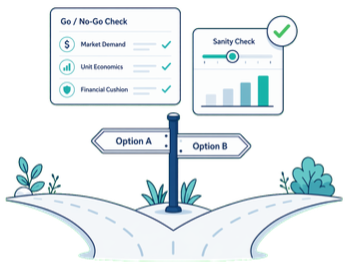
Where you trade
The guide above works as a general planning framework. Pick your country for rules, taxes and local context.

Checklist
FAQ
Start with conservative local evidence for demand, pricing, direct costs, staffing, rent and startup money. The simulator turns those assumptions into revenue, cost, profit, break-even and payback outputs.
No. Calculations are deterministic and based on the assumptions you enter. AI-generated text only explains results and does not recompute them.
No. Use it as an early planning tool and verify assumptions with qualified advisers, quotes and local market evidence.
Sources
Disclaimer: smallbizsim.com provides indicative planning estimates only. It is not financial, legal, tax or investment advice. Verify assumptions with qualified advisers before making decisions.