Inventory is cash on shelves
Retail feasibility is shaped by stock turn, shrinkage, markdowns and the money tied up before items sell.
Source: ATO
Business guides
A mobile accessories store in Adelaide needs to solve urgent, visible device problems fast. The business works when the assortment matches the exact foot traffic rather than trying to stock every possible phone item.
Overview
Adelaide can support mobile accessory retail where impulse replacement and emergency need are strong enough to beat online shopping. CBD and mall-style locations may suit chargers, cables and fast replacements, while neighbourhood strips might rely more on cases, gifting and light service. Use the simulator to test accessory mix, price bands, bundling and any repair-related labour separately because this is a margin-and-stock-turn business. The smaller market rewards sharp assortment decisions and quick service more than catalogue sprawl.
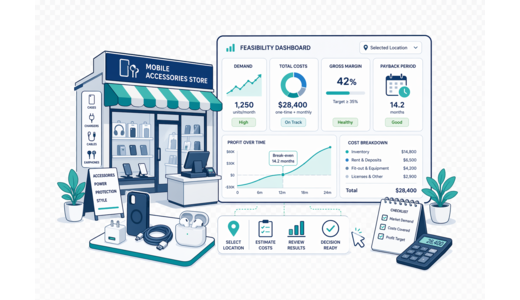
Key stats
Inventory is cash on shelves
Retail feasibility is shaped by stock turn, shrinkage, markdowns and the money tied up before items sell.
Source: ATO
Consumer law follows the sale
Returns, guarantees, product claims and pricing practices need to be built into store operations from day one.
Source: ACCC
Foot traffic is not demand
Retail guides and landlords talk about exposure, but feasibility depends on the share of passers-by who stop, buy and return.
Source: business.gov.au
Key concepts
A CBD or Rundle Mall-style location may need fast-moving essentials for commuters, students and visitors, while a neighbourhood strip may sell more gifting and protective accessories. Adelaide is compact enough that the wrong assortment becomes obvious quickly.
The store should solve visible device problems with minimal friction. If customers have time to think too long, they may simply order online instead.
Accessory retail can look attractive because items are small, but slow-moving variants still tie up working capital. Use stock-turn rules and keep close control of device generations and colour options.
If you add repair-adjacent services, model the bench time, training and warranty implications separately. Service can stabilise traffic, but it changes the operating model.
Audience and industry
Customers for a mobile accessories store in Adelaide should be described by routine, not by broad demographics. Identify who buys, when they buy, how often they return, what alternatives they compare, and how far they will travel. For this business, the first demand hypothesis to prove is repeat local demand, visible catchment fit and sustainable booking or transaction volume.
Customers compare common accessories easily, so the store needs visibility, speed and a clear reason to buy now. Adelaide rewards operators who understand whether the traffic is commuter, student, tourist or neighbourhood repeat traffic and stock accordingly.
Competition in Adelaide is not just the nearest similar operator. Include substitutes, online options, supermarkets, gyms, marketplaces, delivery platforms, shopping centres, petrol sites, home alternatives and any business that solves the same customer problem. Visit competitors at the same times you expect to trade.
Key factors
Proof of repeat local demand, visible catchment fit and sustainable booking or transaction volume in the exact Adelaide catchment.
Rent, outgoings, lease obligations and fit-out spend compared with conservative sales.
capacity utilisation, staffing coverage, customer experience, stock or equipment control and repeat sales routines
contribution margin after direct costs, labour pressure and occupancy cost
Enough cash to survive delays, learning, seasonality and slower repeat-customer growth.
Finance model
Business Model Canvas
Specific Adelaide customers with repeat need for repeat local demand, visible catchment fit and sustainable booking or transaction volume.
A mobile accessories store offer that is easier, faster, more trusted or more local than the alternatives.
Street visibility, local search, referrals, social proof, partnerships, delivery or marketplace channels as appropriate.
Sales driven by repeat local demand, visible catchment fit and sustainable booking or transaction volume; test price, volume and repeat rate separately.
rent, wages, supplies, product cost, utilities, insurance and payment fees; split fixed costs, variable costs and launch costs.
capacity utilisation, staffing coverage, customer experience, stock or equipment control and repeat sales routines
A suitable site or channel, trained people, reliable suppliers, systems, permits and enough runway.
Landlord, suppliers, advisers, local marketers, delivery or fulfilment providers, and maintenance support.
Evidence-based assumptions, staged spending, conservative break-even checks and clear exit conditions.
Common mistakes
Buying every possible variant
Focus on the device mix the catchment is most likely to need.
Competing on catalogue breadth alone
Win on convenience, speed and problem solving instead.
Ignoring ageing stock
Move quickly on slow lines before they become dead inventory.
Case studies
A compact scenario showing how one assumption can change the result.
A compact scenario showing how one assumption can change the result.
Decision tree
Move to rent, capacity and margin stress tests.
Keep researching, pre-selling or testing with a smaller commitment.
Review startup risk, funding and compliance with advisers.
Renegotiate rent, reduce scope, change location or pause.
Prepare a launch plan with measured weekly review points.
Fix capacity, staffing, supplier or process constraints before spending more.
Self-evaluation
Early stage: tighten the assumptions before treating this as feasible.
Decision point
Use the simulator as a structured sanity check. It should support adviser conversations, not replace them.
Test your idea
Where you trade
The guide above works as a planning framework. Confirm the rules, taxes and local context below before you commit.

Checklist
FAQ
Usually somewhere with strong impulse or emergency purchase behaviour, such as city shopping, commuter routes or compact neighbourhood strips where people want a quick fix now.
Only if you can support the skill, workflow and warranty expectations. Repairs can help traffic, but they create a different labour and risk profile from simple accessory retail.
Deep enough to solve the most likely device problems for your traffic, but not so deep that slow variants trap cash. Start narrower and expand from evidence.
No. It is early planning support to help you structure assumptions before seeking qualified advice on finance, tax, lease, employment and compliance matters.
Sources
Disclaimer: smallbizsim.com provides indicative planning estimates only. It is not financial, legal, tax or investment advice. Verify assumptions with qualified advisers before making decisions.